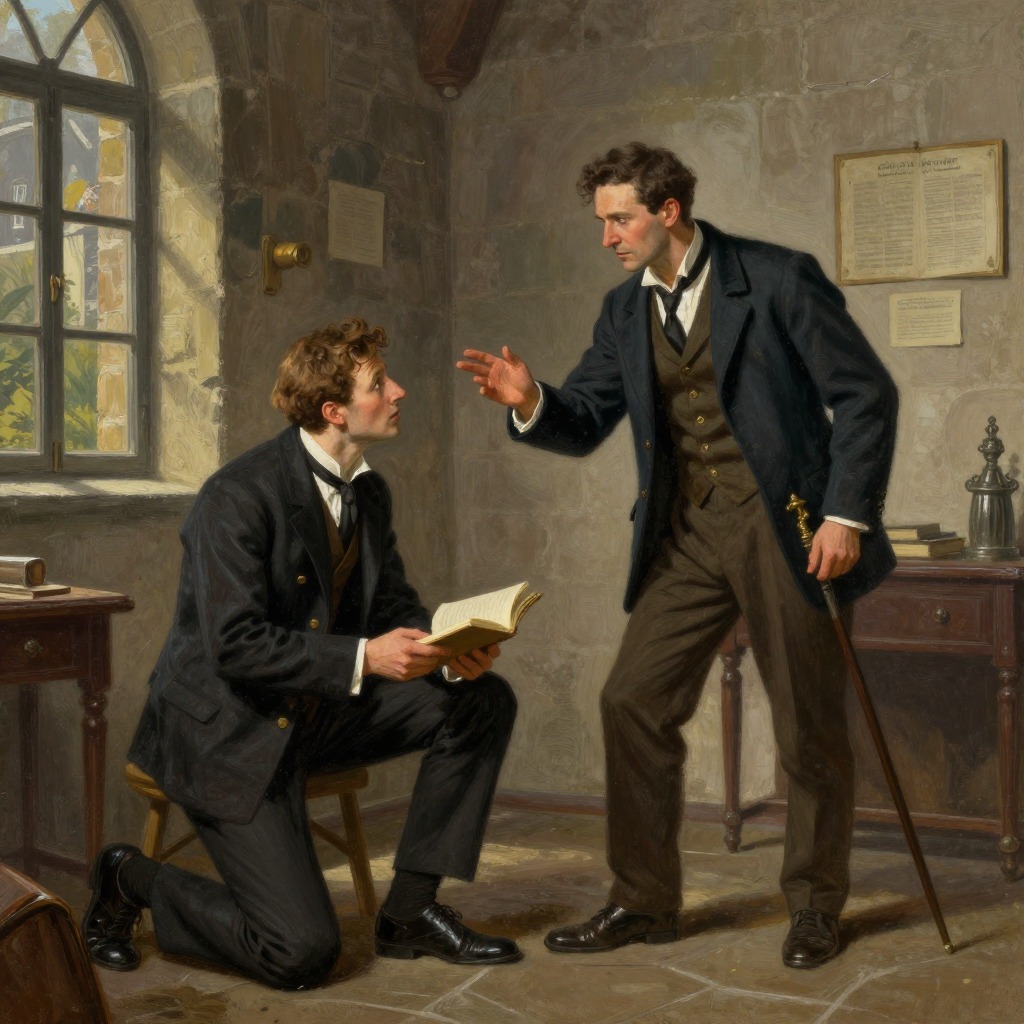
Central Office
Central Office is the administrative heart of the castle, the unseen authority that first acknowledges K.'s existence through a telephone call on his very first night in the village. It is the source of the official letters that alternately raise and dash K.'s hopes, and the engine of a bureaucracy so vast and intricate that its decisions seem to arise from nowhere, answerable to no one. Central Office embodies the castle's paradoxical nature: it is at once the ultimate arbiter of K.'s fate and a phantom entity whose workings remain perpetually opaque, leaving K. to navigate a system that appears to function with flawless logic yet produces only confusion and delay.
The First Contact: A Telephone Call in the Night
Central Office enters the narrative through the telephone at the Bridge Inn, a device that Schwarzer, the castle warden's son, uses to verify K.'s claim to be a land surveyor. The call is placed to a deputy warden, Mr Fritz, who in turn contacts Central Office. The initial response is a flat denial: "There's no record of any land surveyor; this is a common, lying vagabond and probably worse." But a second call, moments later, reverses this verdict, with Schwarzer reporting, "A mistake, then? This is very awkward for me. You say the Office manager himself telephoned?" This sequence establishes Central Office as a place where decisions are made with astonishing speed—"Central Office was working even at night, and clearly it answered questions quickly"—yet where the truth of any given answer is always in doubt. The telephone itself becomes a symbol of the castle's inaccessibility: the village mayor later explains that calls to the castle ring in "all the lower departments," and that the only "real, trustworthy information" the telephone conveys is a "rushing, singing sound," while any actual answer is likely "only a joke." Central Office, then, is not a place one can reach; it is a force that reaches out, arbitrarily, to acknowledge or dismiss.
The Letters: Official Recognition and Its Ambiguities
The first tangible product of Central Office is the letter delivered by Barnabas, signed by the "Chief Executive, Office X," which announces that K. has been "taken into the count's service." The letter is a study in contradictions: it addresses K. as a free agent whose "autonomy" is recognized, yet also as a "common labourer" answerable to the village mayor. K. reads it as an intentional ambiguity, a choice offered to him: to be a village worker with only a seeming link to the castle, or to accept a deeper, more precarious connection. The letter's signature is illegible, but the name "Klamm" is supplied by Barnabas, linking Central Office to the novel's most powerful and elusive official. A second letter, delivered later, praises K.'s "surveys" that he has never performed, and assures him that "the matter of your remuneration will be decided very soon." K. dismisses it as "a misunderstanding," yet the letters themselves, whatever their content, are the only concrete evidence that Central Office knows he exists. They are, as the village mayor notes, "private letters" rather than official communications, but their private significance is "very great, generally greater than an official meaning can ever be."
The Bureaucratic Labyrinth: Departments, Files, and Supervisory Authorities
The village mayor's account of K.'s appointment reveals Central Office as a labyrinth of departments—Department A and Department B—whose miscommunications have produced the very confusion that now entraps K. A decree from Department A, years old, had called for a land surveyor, but the village's reply went astray, reaching Department B instead. There, the conscientious official Sordini, an Italian, seized upon the empty file cover and initiated a correspondence that dragged on for years, generating towers of files that "are always collapsing" in his office. The mayor explains that the authorities "do not even consider the possibility of mistakes being made," and that supervisory authorities exist not to detect errors but to confirm their impossibility. Central Office, in this telling, is a self-justifying system: "Are there supervisory authorities? There are only supervising authorities." The mistake in K.'s case is acknowledged only to be dissolved into the larger question: "who's to say that it's really a mistake in the long run?" This is the essence of Central Office's power—it absorbs all error into its own logic, leaving the individual with no ground to stand on.
The Village Secretary and the Only Way to Klamm
Central Office's reach extends into the village through officials like Momus, Klamm's village secretary, who works for two masters, Klamm and Vallabene. Momus's office is to record all of Klamm's written business in the village, and the landlady insists that his records are "the only real official connection" K. can have with Klamm. Yet Momus himself admits that Klamm never reads the records: "Klamm can't read all the records, in fact he never reads any of them." The records, then, are a dead end, a ritual of documentation that serves only to maintain the appearance of order. Central Office, through its secretaries, thus offers K. a path that leads nowhere, a bureaucratic simulacrum of access. K.'s refusal to be questioned by Momus—"I have a rooted dislike of any kind of questioning"—is a rebellion against this system, a refusal to participate in a process that can only entangle him further.
The Distribution of Files: A Morning Spectacle of Chaos
In the novel's final chapters, K. witnesses the daily distribution of files in the corridor of the Castle Inn, a scene that lays bare the inner workings of Central Office's machinery. Servants push a trolley laden with files, comparing numbers on doors with numbers on lists, while gentlemen in their rooms negotiate, protest, and sometimes hurl files back into the corridor. The process is chaotic, marked by "negotiations" that drag on for hours, and by the servants' desperate attempts to placate the officials. K. observes that the distribution "must take place with the doors almost closed," because the gentlemen, "just after waking up in the morning," are "too bashful, too vulnerable, to be exposed to the glance of strange eyes." This spectacle reveals Central Office as a system of pure process, where the content of the files is secondary to the ritual of their circulation. The files themselves are almost incidental; what matters is the endless, self-perpetuating activity of the bureaucracy. K.'s presence in the corridor is a violation of this order, and he is scolded by the landlord and landlady for having "no right to be in the corridor," a transgression that nearly brings the entire system to a halt.
Significance: The Unknowable Center
Central Office is never seen, never entered, and never understood. It is the absent center around which the entire novel revolves, a force that shapes K.'s every action while remaining perpetually out of reach. Its telephone calls, letters, and files are the only evidence of its existence, yet each of these is shown to be unreliable, ambiguous, or meaningless. Central Office thus embodies the novel's central theme: the inaccessibility of authority and the futility of the individual's struggle against a system that operates according to its own inscrutable logic. K.'s quest to reach the castle is, in effect, a quest to reach Central Office, and its failure is preordained, for the office exists not to be reached but to be endured. In this, Central Office is not merely a bureaucratic institution but a metaphysical one, a symbol of the unbridgeable gap between the human and the divine, the individual and the absolute.